Nonogram vs Sudoku: Which Logic Puzzle Fits You Best?
Table of Contents
- Nonogram vs Sudoku: Key Differences and Similarities
- How Does a Nonogram Work? Steps, Rules, and Payoff
- How Does Sudoku Work? Rules, Techniques, and Flow
- Which Puzzle Matches Your Goals? Time, Mood, and Skills
- Comparison Table
- Nonogram Strategy vs Sudoku Strategy: What Actually Works
- In Practice: What Solvers Prefer and Why
- Health and Cognitive Angle: What the Research Suggests
- How to Choose: A Simple Decision Framework
- Where to Practice and Build Skill
- A Note on Learning Curves and Plateaus
- Advanced Variants if You Want More Challenge
- Why Nonogram vs Sudoku Is Not Either/Or
- Sources and Credible References
- Key Takeaways
Nonogram vs Sudoku: choose Nonograms if you enjoy visual-spatial reasoning and picture reveals; choose Sudoku for pure numeric deduction. Both build logic, but their feel, strategies, and rewards differ.
If you’re short on time, start small with Nonograms to train patterning quickly; when you want an extended mental workout, pick Sudoku.
I’ve taught logic puzzle workshops for years, and the same question keeps coming up: Nonogram vs Sudoku — which puzzle should I invest in? The short answer is that your goals decide. Visual thinkers thrive on Nonograms, while number-focused solvers love Sudoku’s symmetry and logic chains.
Nonogram vs Sudoku: Key Differences and Similarities
Both are deterministic, no-guess logic puzzles, but they engage your brain differently.
- Nonograms encode a hidden image using row/column counts; Sudoku enforces 1–9 uniqueness in rows, columns, and boxes.
- Nonograms reward visual progress (filling cells and marking Xs), while Sudoku rewards constraint propagation and number placement.
- According to Wikipedia’s Nonogram entry, the format emerged in the late 1980s and emphasizes picture logic; Sudoku’s modern popularity surged in the 2000s, emphasizing combinatorial reasoning.
- If you’re deciding now, see the comparison for a quick side-by-side.
How Does a Nonogram Work? Steps, Rules, and Payoff
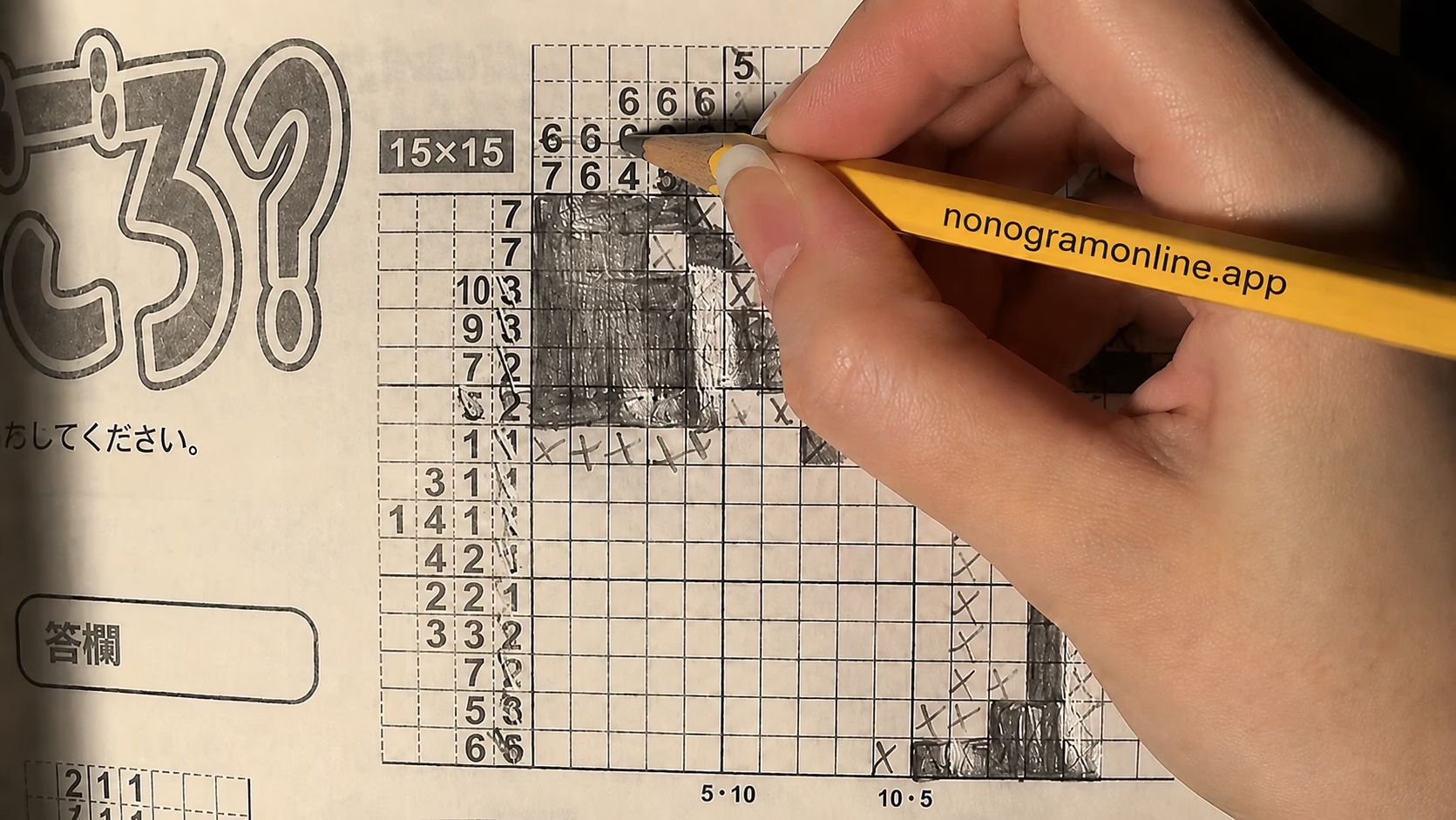
Nonograms (a.k.a. Picross, Griddlers) display number sequences for each row and column. Those numbers tell you how many consecutive cells are filled, in order, with at least one blank between groups.
Basic solve loop:
- Scan for "full fits": If a 10-cell row shows "10," fill the entire row.
- Use overlaps: On a 10-cell row "7" must occupy the middle cells (positions 2–8) at minimum; mark guaranteed cells.
- Alternate fill and X: Every time you confirm a block, mark surrounding forced blanks to unlock new deductions.
- Cross-check columns vs rows to cascade progress.
Why it matters: Nonograms train spatial chunking, pattern detection, and disciplined marking. They offer immediate visual feedback — the picture emerges as you reason.
How Does Sudoku Work? Rules, Techniques, and Flow
Sudoku uses a 9×9 grid divided into 3×3 boxes. Each row, column, and box must contain digits 1–9 exactly once.
Core techniques:
- Singles: Naked singles (only one candidate in a cell) and hidden singles (a digit can only fit one cell in a unit).
- Candidate elimination: Use pencil marks to track possibilities; remove candidates using row/column/box interactions.
- Intermediate strategies: Pairs/triples, X-Wing, Swordfish, and coloring extend reach without guessing.
Why it matters: Sudoku builds systematic elimination, working memory, and logical flow. It’s a clean test of constraint satisfaction with numeric symbols.
Which Puzzle Matches Your Goals? Time, Mood, and Skills
If your priority is a quick, satisfying session and an artful payoff, Nonograms excel. If you want a meditative, numbers-first deduction flow, Sudoku wins.
Try this chooser:
- Need fast wins or on mobile? Pick a 5×5 or 10×10 Nonogram.
- Want deeper, longer runs? Choose a Standard Sudoku or move to harder variants.
- Prefer pictures and spatial logic? Go Nonogram.
- Love digit logic and structured grids? Go Sudoku.
Comparison Table
| Factor | Nonogram | Sudoku |
|---|---|---|
| Core mechanic | Row/column run-length clues create a pixel image | 1–9 uniqueness in rows, columns, boxes |
| Primary skills trained | Visual-spatial reasoning, pattern chunking | Deductive reasoning, candidate tracking |
| Learning curve | Moderate at first, then smooth with overlaps | Gentle start; advanced techniques ramp difficulty |
| Typical beginner session | 5–15 minutes (5×5 to 10×10) | 10–30 minutes (easy to medium) |
| Feedback style | Immediate visual reveals (fill + X marks) | Numeric confirmations as candidates collapse |
| Error detection | Visual misalignment reveals contradictions | Duplicate digits flag contradictions |
| Accessibility | Works well without numbers; great visually | Number symbols only; low visual art component |
| Difficulty scaling | Grid size and clue density | Fewer givens, trickier patterns |
| Common mistakes | Not marking Xs; miscounting runs | Skipping pencil marks; missing singles |
| Best for | Quick, artful logic; spatial training | Systematic number logic; long-form focus |
Nonogram Strategy vs Sudoku Strategy: What Actually Works
Effective nonogram strategy:
- Always pair fills with Xs. Marking forced blanks prevents later contradictions.
- Use overlap math early. For run "7" in 10 cells, the central 4 are guaranteed.
- Sweep in both directions: After each row pass, recheck columns for new forced placements.
Effective sudoku strategy:
- Pencil marks everywhere. Track candidates meticulously to enable advanced eliminations.
- Prioritize singles first, then pairs/triples before jumping to X-Wing or Swordfish.
- Re-scan after every placement; new singles often appear after a single deduction.
Expert perspective: "Nonograms train you to see constraints as shapes; Sudoku trains you to see constraints as sets. Switching between the two is cross-training for reasoning," says Marco Iwata, PhD, puzzle designer at LogicGrid Labs.
In Practice: What Solvers Prefer and Why
From working with mixed groups, I see patterns:
- Visual creatives (designers, illustrators) lean Nonogram for the picture payoff and spatial reasoning flow.
- Engineers and math-minded solvers often prefer Sudoku for its crisp numeric structure and reproducible strategies.
- Busy professionals grab Nonograms during short breaks; Sudoku anchors longer, focused sessions.
When people ask which puzzle is harder, I explain that "hard" depends on your native strengths: Nonograms punish sloppy marking; Sudoku punishes skipping candidate logic.
Health and Cognitive Angle: What the Research Suggests
Puzzles are a low-risk way to engage working memory and attention. NIH communications highlight that mentally stimulating activities support healthy aging, though they’re not a cure-all (NIH).
- Nonograms emphasize visual-spatial reasoning and chunking, beneficial for pattern recognition circuits.
- Sudoku emphasizes working memory and set-based deduction.
Broader cognitive science literature shows problem-solving and pattern learning drive plasticity under the right conditions (Nature). Use puzzles as part of a balanced cognitive routine including exercise and sleep.
How to Choose: A Simple Decision Framework
Use this 5-step filter:
- Timebox: Under 15 minutes? Start with a 5×5 or 10×10 Nonogram.
- Mood: Want a picture payoff? Nonogram. Prefer numbers-only focus? Sudoku.
- Skill goal: Visual-spatial upgrade? Nonogram. Candidate logic and elimination? Sudoku.
- Environment: On the go? Nonogram scales well to small screens. At a desk? Sudoku notebooks or apps shine.
- Progression: Alternate weekly to cross-train and avoid plateau.
Where to Practice and Build Skill
If you’re new to Nonograms, start small and scale deliberately:
- Begin with a 5×5 grid to learn marking discipline on 5×5 Nonograms — Play Online Free 🧩.
- Move to 10×10 for richer overlap logic on 10x10 Nonograms — Play Online Free 🧩.
- When ready, tackle denser logic on 12x12 Nonograms — Play Online Free 🧩.
- Prefer a library? Explore Free Nonograms Online — Play & Solve Puzzles 🧩.
For Sudoku, a wide range of apps and books exist, and the classic rules are summarized well on comprehensive references such as Wikipedia’s Sudoku overview. If you want daily discipline, set a 15-minute timer and track streaks.
A Note on Learning Curves and Plateaus
- Nonograms: Early wins come from overlaps and full-fit rows; you’ll plateau until you rigorously mark Xs and exploit advanced edge cases (like counting from both ends and identifying mandatory gaps between runs).
- Sudoku: Most solvers stall after singles. The leap comes from mastering pairs/triples and the first grid-spanning techniques (X-Wing). Don’t skip pencil marks.
Advanced Variants if You Want More Challenge
- Nonograms: Larger grids (15×15, 20×20), colored Nonograms, and mixed-size packs.
- Sudoku: Killer Sudoku, Samurai, and variant constraints (diagonal, irregular) that emphasize deeper set logic.
Why Nonogram vs Sudoku Is Not Either/Or
Treat Nonogram vs Sudoku as complementary. Alternating sessions builds broader problem-solving capacity and keeps motivation high. It’s mental cross-training.
As a veteran coach, my best-performing students schedule two short Nonogram sessions during the week and one longer Sudoku on weekends. Consistency beats intensity.
Sources and Credible References
- Historical context and rules on Nonograms: Wikipedia
- Cognitive engagement and healthy aging guidance: NIH
- Cognitive science and learning research coverage: Nature
Key Takeaways
- Choose Nonograms for visual-spatial reasoning, quick wins, and picture reveals; choose Sudoku for numeric deduction and deep focus.
- Start small: 5×5 and 10×10 Nonograms build confidence fast; then scale to larger grids.
- In Sudoku, pencil marks and methodical scanning prevent stalls; learn pairs/triples before advanced patterns.
- Alternate Nonogram vs Sudoku weekly for balanced cognitive training and sustained motivation.
- Use the comparison table and your time/mood goals to pick the right puzzle for each session.
FAQ
Both are beginner-friendly. Start with 5×5 or 10×10 Nonograms for quick wins, or an easy Sudoku to learn singles and pencil marks.
Difficulty depends on strengths. Nonograms tax visual-spatial logic and marking; Sudoku taxes candidate tracking and numeric deduction.
A 5×5–10×10 Nonogram takes 5–15 minutes; an easy-to-medium Sudoku takes 10–30 minutes. Larger or trickier variants run longer.
They engage attention and working memory. NIH notes mentally stimulating activities support healthy aging, but they aren’t medical treatments.
Timebox sessions, track streaks, and alternate Nonogram and Sudoku weekly to avoid plateaus and build complementary skills.